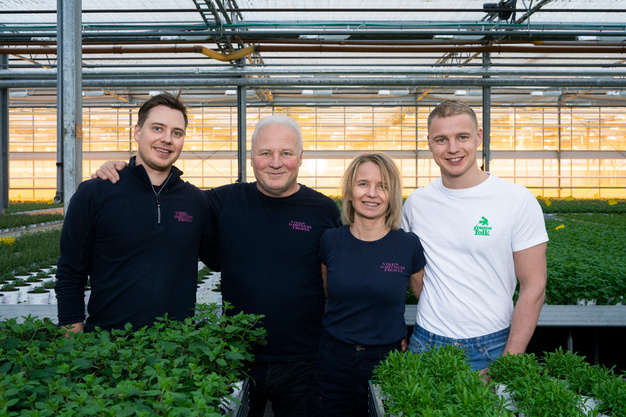
The promise of vertical farming is year-round production, at whatever latitude you are. The reality is that operating those farms is financially challenging. Karl Martin from Viken Gartneri knew he could scale up the family greenhouse business with that setup. Yet, he rejected it; he needed something hybrid. “1+1=3,” he says.
 © Viken Gartneri
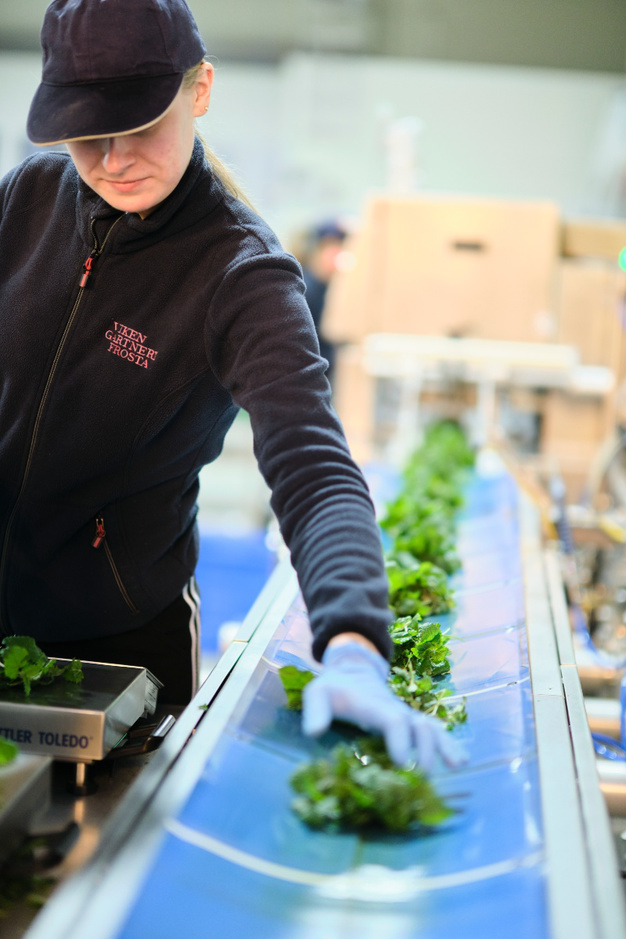
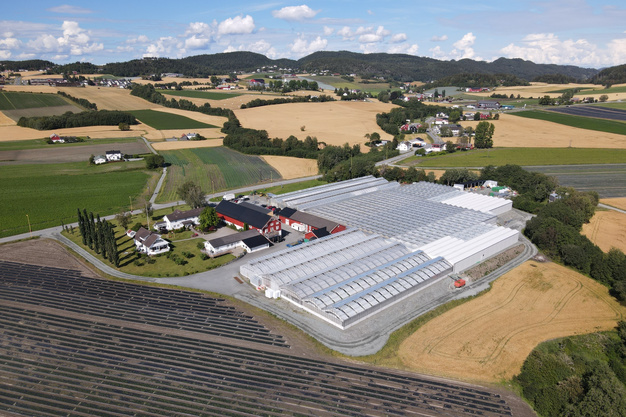
Norway has long had year-round potted herb production, but supplying fresh-cut herbs grown domestically through the full year was a different matter entirely, until Viken Gartneri made it work. Karl Martin has been running fresh-cut herb and crisp lettuce production out of a 15,000 square meter site in Viken for years. The farm was set up back in the 90s, starting from some 600 sqmt, with a focus on lettuce, “because that’s what the market demanded,” Karl says. The company expanded over the years, to the point that, in 2020, together with one of Norway’s major supermarket chains, became the first grower in the country to supply fresh-cut herbs year-round. “We started locally, and now we deliver almost all over the country for that chain,” Karl says.
The company now runs a second site of around 8,000 square meters for potted herb production, and delivers to both supermarkets and foodservice. “We always look at different crops and such. But we’ve been growing lettuce and herbs successfully for almost 30 years, so we stick with what we know best.”
 © Viken Gartneri
Expanding to meet growing demand meant Karl had to make a call on how to add production capacity. Vertical farming was an obvious candidate, but it wasn’t one he was willing to make. “Vertical production itself is not fully sustainable from an energy standpoint,” he says. Considering the Norwegian environment, it makes sense that Karl is laser-focused on energy efficiency. Heating up and illuminating an entire farm while outside is dark for most of the day and temperatures are Pluto below zero is unimaginably costly. And in a vertical setting, you take out that one element that may help you save costs. “Why should you close out the sunlight, when that’s free?”
Straight-up greenhouse expansion, however, left the heating problem unresolved. Energy is the dominant cost for a Norwegian greenhouse grower, and with prices volatile, Karl wasn’t prepared to grow the business on an assumption of stable energy costs. “We are a family business that always thinks long term. We are thinking five years, ten years, twenty years ahead.” So, he thought, why not a bit of both vertical farms and greenhouses?
A greenhouse-vertical farm Frankenstein hybrid
Protected cropping works in a closed loop, whether it be a vertical farm or a greenhouse. For this loop to work, countless variables and elements need to work in unison, or as close as possible to that. Heat is one of these elements, and one of the costliest; Karl found a way to make it work twice.
 © Viken Gartneri
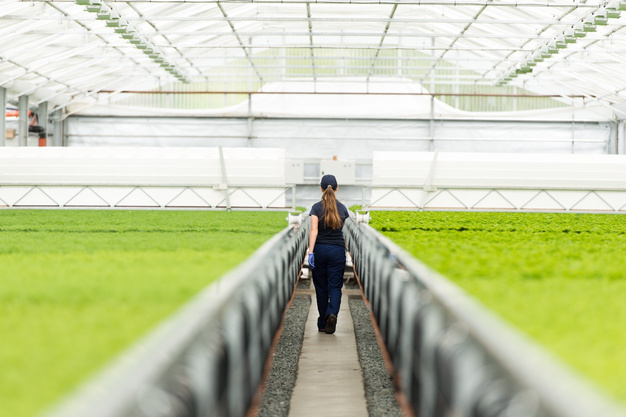
The model he built keeps the vertical farm and limits it to nursery production. Every plant, lettuce and herb, spends sixteen days in the vertical setup before moving to the greenhouse for the final two weeks of its growth cycle. “We deliberately only grow small plants in the vertical farm. We start them off there, and then move them to the greenhouse.” Small plants equal small biomass, which is the key in Karl’s method. “Air movement is crucial to have good growth.” It goes without saying, but with smaller plants, it’s easier to manage air movement. “To have uniformity in air movement in a vertical farm is difficult and challenging. But we don’t face that problem if we grow small plants.” The controlled environment of the vertical farm also gives Karl a stable, consistent propagation stage. “We get excellent young plants because we have full control of humidity, temperature, and light,” he says. “That is the starting point for everything that follows in the greenhouse.” The standalone vertical farm is connected to the greenhouse, supplying it with heat. “Most of the heat we use for vertical is extracted and put into the greenhouse,” Karl explains. Thanks to that, heating costs at Viken Gartneri are already down around 40%, with potential to push that to 80% as heat storage and pump performance improve through the coldest months. “This is a 1+1=3. You take the best part of both productions and combine them to get something new.”
The combination is essential for Karl and Viken Gartneri to fit their sustainability efforts. “The less energy we use, the better our activity is for the climate. The most important thing is to use as little energy as possible per product.” The energy source matters less than the quantity consumed, he argues. Climate is a global problem, and the only meaningful contribution is using less. It’s also, not coincidentally, the only way to keep costs under control. “We can’t forget that growing the product is the main thing we are doing.”
 © Viken Gartneri
Norwegian consumers as well are very much aware of climate change issues, and their purchasing decisions can be based on that as well. It’s not surprising that they are increasingly buying domestic, and Karl says he sees it across categories. “Cucumber production has gone from roughly 50% domestic market share to near-total local supply within a decade. Tomatoes are moving the same way. Herbs were already mostly domestic, driven by shelf life. Lettuce sits partially outside that trend; Spanish iceberg and little gem cover the winter gap, varieties that don’t suit indoor cultivation, but the direction of the market is consistent. We see that the market wants more domestic production.”
Vertical farming has been promoted as one of the main allies of domestic production. Wishful thinking clashed with reality, and many companies bit off more than they could chew, with dramatic headlines as testament. Karl knew that vertical farming ticked all the boxes to expand their production, but math didn’t add up, and that’s how he ended up with a Viken Gartneri vertical farm-greenhouse hybrid. He is, anyway, quick to point out that his method doesn’t necessarily work for a grower at a different latitude. “What works for me doesn’t have to work for somebody else growing, say, in South America,” he says. “Our main challenge growing in Norway is heating, and we did our hybrid setup to address that aspect. Perhaps there are other principles from vertical farming that can be better promoted in a greenhouse, depending on the geography.”
For more information:
Viken Gartneri Frosta
VIKEN ØSTRE GARTNERI
7633 Frosta
Tel: +47 74 80 77 98
www.vikengartneri.no
Source: The Plantations International Agroforestry Group of Companies