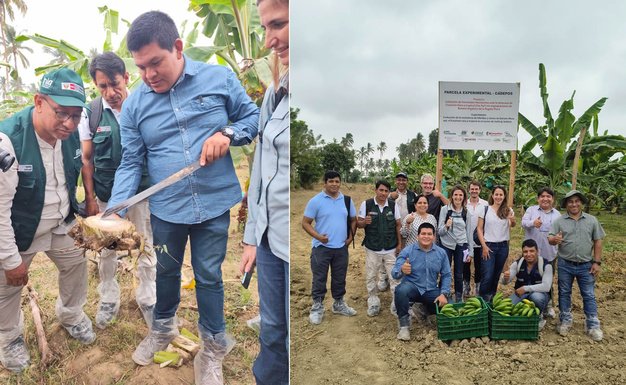
Between 20 and 24 July, researchers from CIRAD paid their second visit to the project. During the visit, the team inspected three trial plots: the Virgen del Carmen cooperative in Salitral and the APBOSMAM cooperative in Garabato, both infected with Fusarium TR4, and the INIA agricultural research institute, which is TR4-free. INIA’s ripening chamber was also inspected. Nicanor Cabrera, Ronald Garrido, and Breyner Rivera took part in the mission on behalf of AgroFair and Tulipán Naranja. They report on the visit.
 © Agrofair
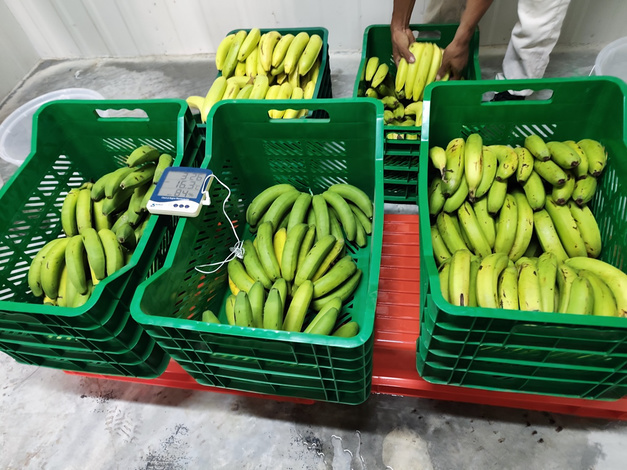
A post-harvest specialist from CIRAD also joined the mission, as the first bunches of the CIRAD 965 and CIRAD 966 varieties were ready for harvest as early as the end of July. For these two varieties, the interval between harvests is much shorter than for Cavendish and the CIRAD 931 and 938 varieties. The mission was once again able to confirm first-hand that the four CIRAD varieties were resistant to TR4. Almost all the Cavendish plants serving as a control group on the infected plots had completely withered after just a few months. On two plots, yellowing at the edges of the banana leaves was observed on some of the CIRAD 965 and 966 plants. It remains to be determined whether this is due to a lack of fertiliser or to the salt content of the soil.
 © Agrofair
Dramatic situation for Peruvian banana growers
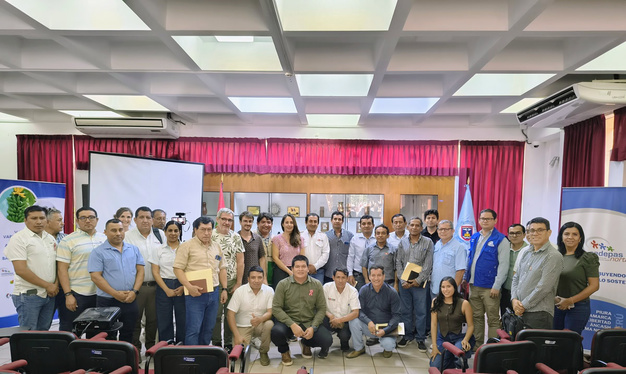
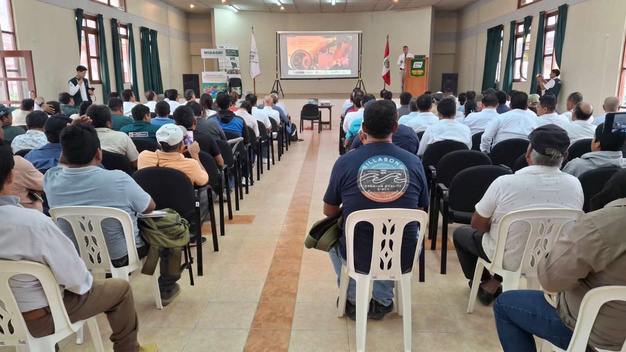
On the morning of Wednesday 22 July, a meeting with producers was held in the INIA auditorium. Due to the increase in the number of infections, particularly in the Chira Valley and especially in the municipalities of Querecotillo, Sullana, Salitral, and Marcavelica, the situation can be described as dramatic. According to figures from the phytosanitary service SENASA, the banana plantations of many hundreds of farmers have been affected either partially, covering 4,521 ha, or to a very large extent, covering 2,139 ha. These areas represent 26 per cent and 12 per cent of the total, respectively. In addition, the first cases of TR4 have been detected on a further 2,476 ha, or 14 per cent. Less than half of the total area under banana cultivation for export, 17,355 ha, remains completely free of TR4, at 8,219 ha, or 47 per cent. Understandably, many farmers are desperate, as they made clear during the meeting. They would prefer to switch to resistant varieties as early as tomorrow.
 © Agrofair
Resistant varieties: Promising, but not yet an immediate solution
Unfortunately, CIRAD’s resistant varieties do not yet offer an immediate solution. It will only be with the third generation, with harvests expected in July 2027, that we can say anything with greater certainty about the level of resistance under Peruvian conditions, including soils and climate. In addition, it remains to be seen what the potential yields and possible net incomes are, how these varieties should be ripened, and whether these bananas, which are not Cavendish, will be popular with consumers. Another variety being tested by INIA, the ‘Formosana 218’, a Cavendish variety, shows some degree of resistance, but does not survive for long in heavily infected soil. A mass switch to Formosana is therefore not a likely prospect.
Healthy soils and biosecurity
Due to the high degree of fragmentation of banana plots and the current method of irrigation, in which plantations are flooded via a system of canals from the Poechos reservoir, implementing effective biosecurity measures in the Chira Valley is difficult. A fence around the plantation, footbaths containing disinfectant chemicals at the entrance, and changing footwear when entering or leaving the plantation are really only feasible for somewhat larger plantations. What appears to have a somewhat inhibitory effect on the spread and impact of the Fusarium TR4 fungus is the promotion of soil biodiversity through the application of Trichoderma, which counteracts the TR4 fungus, biochar, organic fertilisers, and leguminous groundcovers. Several experiments using these methods are currently underway, with promising results. Ideally, the pursuit of healthy soils should go hand in hand with basic biosecurity measures and the introduction of resistant varieties.
 © Agrofair
Outlook
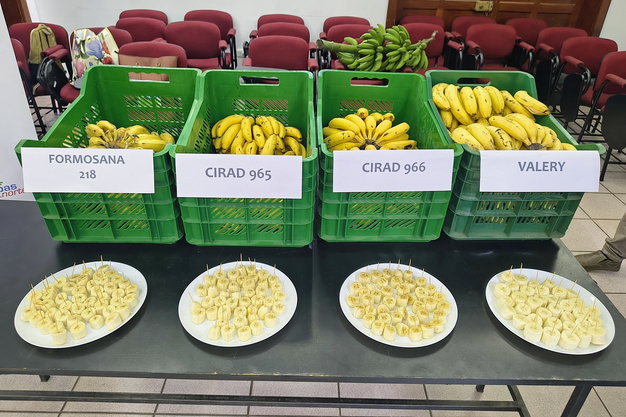
Much of Thursday was taken up by a marathon session involving the project team, specialists from CIRAD, and representatives from AgroFair, to discuss the results to date in detail, set the direction for the next phase, and agree on data collection. On Friday, a closing meeting with guests was organised at the University of Piura, featuring a panel comprising CIRAD, SENASA, and CEDEPAS Norte. At the end of the event, various varieties were also sampled: Formosana 218, CIRAD 265 and 266, and a standard Cavendish. This could not yet be described as a proper taste test, as the participants’ opinions were not recorded according to a protocol.
 © Agrofair
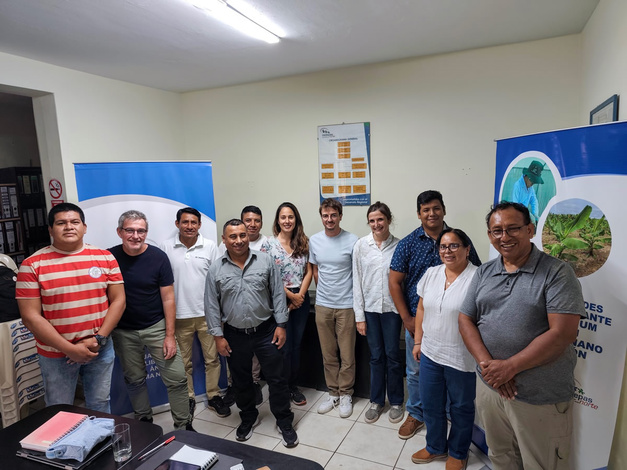
Sometime in September or October this year, co-funding from the Peruvian government program Pro Innovate will come to an end. Over the past few months, a small team from CIRAD, CEDEPAS Norte, and AgroFair has been working on formulating a second phase, so that second- and third-generation banana plants can continue to be monitored on the three trial plots. The level of resistance, yields, and post-harvest qualities, including ripening and taste tests, simulation of sea transport, and packing into standard 18 kg banana boxes, will be the main focus of this phase.
 © Agrofair
The current project partners will remain involved: CIRAD, INIA, the Virgen del Carmen and APBOSMAM cooperatives, the family-run business Fundo Guimoye, the NGO CEDEPAS Norte as the lead implementing organisation, Tulipán Naranja, and AgroFair. The Swiss organisation SECO has agreed to co-fund this second phase, together with AgroFair.
 For further information:
Dr Johannes W.H. van der Waal
AgroFair
[email protected]
www.agrofair.nl

Source: The Plantations International Agroforestry Group of Companies