Potato processing is undergoing a deep transformation, as the need to guarantee increasingly higher quality standards is combined with the growing difficulty in finding labour, thereby accelerating the adoption of advanced technologies along the entire supply chain.
In this context, the Sgorbati Group proposes an approach based on the integration of different technological solutions, with the aim of improving production efficiency and making processes more stable and replicable.
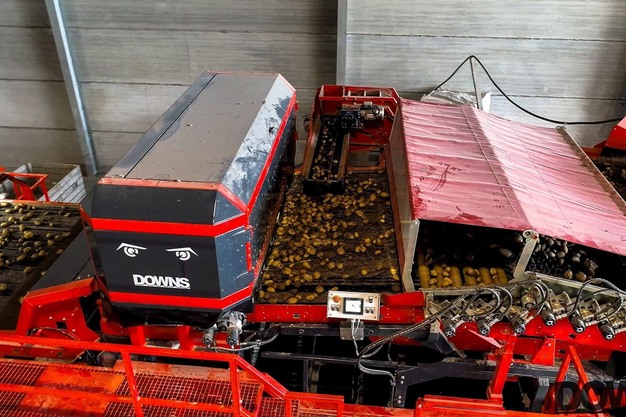 © Sgorbati Group Srl
According to the company, the value of innovations does not reside solely in the individual machines, but in the ability to integrate them within a complete line in which each phase contributes to the final quality of the product.
Proposed technologies include advanced vision systems, product processing and handling solutions, and dust and odour removal systems for healthier, operator-friendly working environments. The aim is to reduce operational variability and ensure consistent results over time, even with non-homogeneous raw materials.
CropVision: Optical sorting on unwashed product
Among the most innovative solutions is Downs’ CropVision, an optical sorter designed to operate directly on unwashed potatoes.
The system uses high-definition cameras and artificial intelligence algorithms to analyse the entire surface of the product. This makes it possible to perform a 360° assessment of each individual tuber, classifying it according to its actual quality.
The technology makes it possible to detect foreign bodies such as stones and clods; recognise defects such as greenness, surface damage, deformations, or rot; and adapt selection criteria according to production requirements. The main benefits include the possibility of working at high speed and a significant reduction in manual work, as well as greater uniformity of the end product.
The application: Consistent quality and less labour
“An Italian cooperative specialising in potato processing recently introduced the CropVision system in its line,” reads a note from Sgorbati Group.
“The main objective was to improve the quality of sorting and, above all, to keep it consistent over time. Manual sorting used to have limitations due to the variability between operators and the difficulty of ensuring uniformity along the different shifts.”
“Since the introduction of the vision system, the cooperative has experienced a significant reduction in the number of staff involved in sorting, greater stability in quality standards, and a better ability to control sorting parameters. An important aspect is the possibility of setting and saving specific sorting criteria, making the process easily repeatable and adaptable to business needs.”
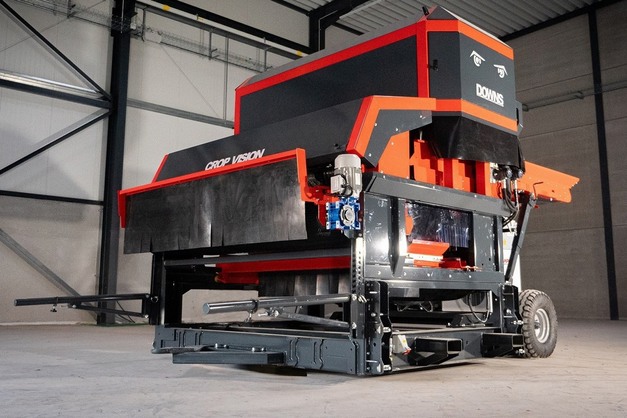 © Sgorbati Group Srl
Towards new quality management
The adoption of machine vision systems marks a paradigm shift in quality management. Sorting, traditionally left to the experience of operators, becomes a measurable and standardised process. Being able to do it with unwashed potatoes allows a major improvement, as sources of contamination are eliminated from the warehouse.
This approach enables companies to improve the uniformity of the product destined for the market, reduce waste, optimise the value of the different categories, and respond more reliably to distribution requirements.
“The integration of automation and visual analysis is one of the main developments for the industry. The possibility of combining different technologies within complete lines makes it possible to deal with operational cost and quality challenges more effectively. For operators in the sector, this is an increasingly strategic move: not only to improve productivity, but also to ensure continuity and control in an ever-changing environment.”
For more information
Sgorbati Group Srl
Via della Musia, 50
25135 Brescia – Italy
+39 (0) 30 2594201
[email protected]
www.sgorbatigroup.com

Source: The Plantations International Agroforestry Group of Companies