“The Ecuadorian pitahaya sector has been achieving nice growth in recent years, with our sales registering constant annual increases. We currently export to some 15 countries in Asia, Europe, the Middle East, and North America. Some of our main destinations are Hong Kong, Singapore, the United Arab Emirates, Spain, France, Germany, the United Kingdom, the United States, and Canada,” says Ramiro Guerrón of Equadragon Fruit.
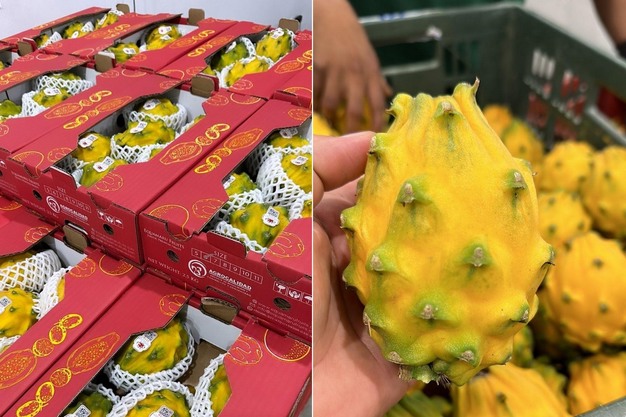
Ecuadorian yellow pitahaya stands out when compared to other international competitors. “Ecuador has a unique yellow pitahaya. We have the Palora variety, which is unique in the world,” says Guerrón. Although China has already started producing this fruit using Ecuadorian plant material, the entrepreneurs argue that the differences in climate and soil make it impossible to achieve the same quality and size. “Their fruit is smaller, and the quality is different,” he said.
 © Equadragon
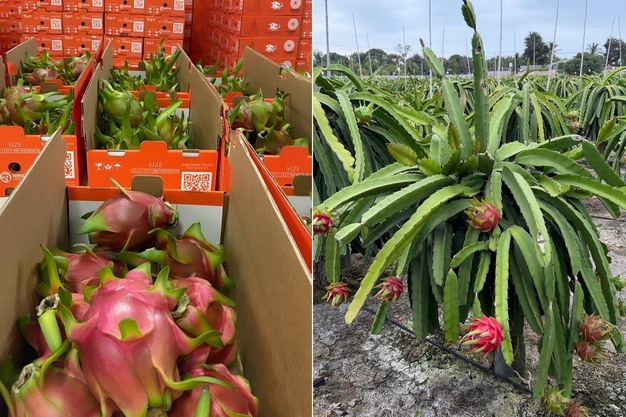
In the case of red pitahaya, most of the competition is in Peru, Asia, and some areas of the United States; however, Guerrón believes that Ecuador has strategic advantages. “Peru doesn’t have access to the U.S. market, and this limits their demand,” he said. He also pointed out that Ecuadorian fruit offers better shelf life and quality conditions than other regional products.
Price behavior is still one of the sector’s main challenges. According to Guerrón, volatility is high and depends on factors such as local production in the United States, Asian supply, and climatic cycles. “There are times when prices are high and other times when the fruit costs pennies,” he said. At the moment, yellow pitahaya prices are high due to the fruit’s low supply.
In the U.S. market, Ecuador also has to compete with California’s pitahaya production, especially during the summer season. Guerrón says that Californian producers mainly supply between May and September, so the demand for imported fruit is lower in this period. However, he stressed that Ecuadorian fruit still has an edge in terms of quality and size. “They produce during the summer, but the quality is different. Their fruit is smaller, and they have had a lot of problems lately,” he says. According to him, Ecuador retains a stronger position on the east coast of the United States, particularly in Miami, where demand for imported pitahaya remains high.
 © Equadragon
Locally, the sector is also facing challenges related to the political and logistical situation in Ecuador. According to Ramiro Guerrón, mobility restrictions due to the security situation have made export operations more difficult. “We are currently under a curfew that is taking a toll on our logistics. We can’t work or go anywhere at night in our province,” he said. On top of that, the overall increases in the costs of fuel, fertilizers, and transportation continue to put the profitability of the export business under pressure.
In recent years, there has been a greater focus on agricultural certifications and residue control in order to gain access to more demanding markets, especially in Europe. “Having a greater certified supply has also helped us grow in Europe,” says Guerrón. He claims that around 90% of the red pitahaya they handle undergoes residue controls or is obtained through chemical-free production.
Despite the growth in demand, the executive warned of the risk of global oversupply, especially due to the expansion of plantations in neighboring countries. “There are times when production becomes volatile, and prices take a dive,” he says.
 For more information:
Ramiro Guerrón
Equadragon Fruit
Ecuador
Tel.: +593 96 331 4701
[email protected]
www.equadragonfruit.com
Source: The Plantations International Agroforestry Group of Companies