India’s potato industry is one of the world’s largest, producing nearly 60 million tonnes annually and supporting a value chain estimated at around USD 13.46 billion. “Yet despite its scale, the sector remains highly fragmented, with farmers, traders, commission agents, transporters, cold storages, processors, institutional buyers, retailers and exporters often operating through separate local networks,” says Praj Thakker of Potato Bazaar.
According to him, this fragmentation means that information on prices, stocks, varieties, demand and buyers is frequently scattered across different markets and relationships. “The resulting information gaps can affect price discovery, supply-demand matching and the ability of businesses to identify new market opportunities.”
“Farmers have limited visibility beyond local markets, while traders struggle to identify new buyers and sellers. Cold storages often cannot efficiently market available stock or capacity, and processors and institutional buyers find it difficult to source potatoes meeting precise specifications,” he adds.
 © Potato Bazaar
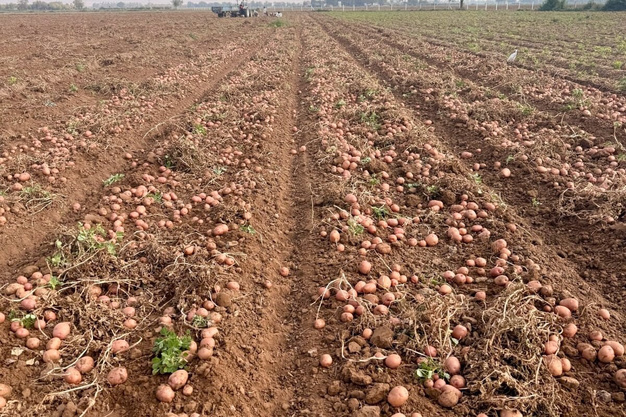
Information gaps affect market efficiency
Much of the discovery process remains relationship-driven: Established businesses can rely on longstanding networks, while smaller farmers and traders often depend on local contacts, phone calls and WhatsApp groups, Praj shares. “This can make it difficult for stakeholders to expand beyond familiar markets or identify new counterparties.”
The impact of fragmentation can also be seen in price differences across the supply chain. Praj shares an example of the 2026 harvest, where farm-gate prices in parts of West Bengal were around USD 0.04–0.06 per kg, while retail prices reached USD 0.15–0.20 per kg. “Logistics, handling, storage and other costs contribute to this difference, but limited transparency and fragmented market information can add further complexity to the movement of produce.”
“The need is not simply more data, but timely, actionable market intelligence,” he highlights.
The need for better connectivity is becoming increasingly relevant as India’s potato industry evolves. “Processing, organized retail, quick commerce and exports are creating demand for more consistent supply, specific varieties and grades, and potatoes suited to defined end uses. These developments require closer coordination between growers, traders, storage operators and buyers,” Praj notes.
 © Potato Bazaar
Building a digital layer
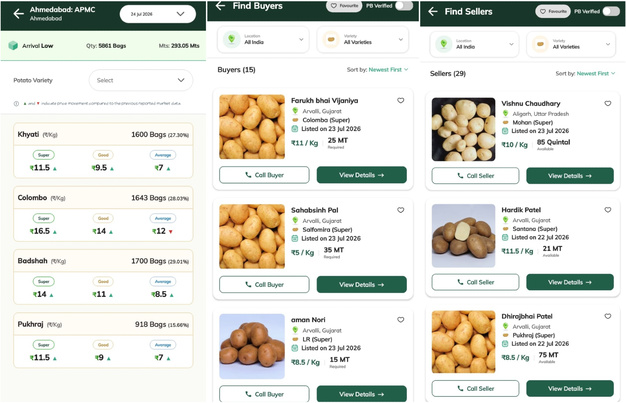
Against this backdrop, Potato Bazaar is attempting to build a dedicated digital platform connecting different parts of India’s potato ecosystem. Rather than focusing solely on trading, the platform aims to bring together farmers, traders, cold storages, processors, exporters, institutional buyers and service providers through market information and business discovery.
“The approach includes access to mandi prices and, in selected markets, variety and grade-level information, alongside tools intended to help buyers and sellers identify potential counterparties. The broader objective is to improve visibility of supply and demand, stocks and storage capacity, while making it easier for businesses to find suitable partners beyond their existing networks,” Praj shares.
“Beyond discovery, we are also working towards enabling trusted transactions through solutions such as escrow payments and auctions, while expanding farmer support through crop diagnostics, agronomy advisory and on-ground engagement. The longer-term vision is to combine market access, transactions, knowledge and advisory within one industry ecosystem.”
However, he acknowledges that digital tools are unlikely to replace the physical relationships that underpin agricultural trade. “Our model combines digital market access with on-ground engagement, reflecting the importance of building trust and encouraging adoption among a highly diverse group of stakeholders.”
 © Potato Bazaar
Connecting India’s potato market
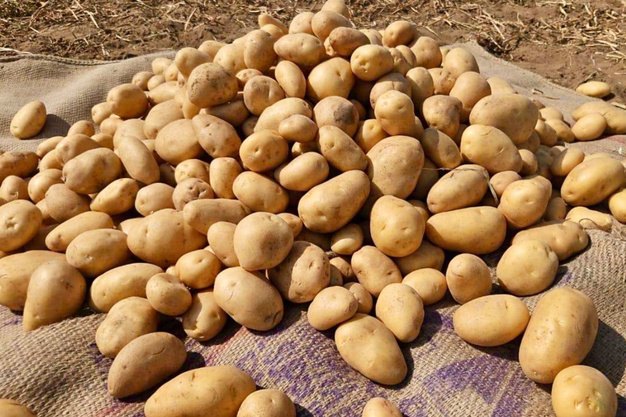
For farmers, better access to price and demand information could improve market visibility, while traders may gain access to a wider pool of buyers and sellers. Cold storages could improve visibility of available capacity and inventory, while processors and institutional buyers could more efficiently identify suppliers matching their requirements.
International connectivity is another potential opportunity. Potato Bazaar aims to help overseas buyers discover Indian suppliers and give Indian exporters greater visibility. However, any resulting transactions will still depend on meeting international quality, phytosanitary and regulatory requirements.
“India already has a large production base, extensive cold-storage infrastructure and significant expertise across its potato industry. The challenge is connecting these capabilities more efficiently to make India’s complex potato ecosystem more transparent, connected and responsive to changing market demand,” Praj concludes.
For more information:
Praj Thakker © Potato Bazaar
Potato Bazaar
Tel: +91 92121 09782
Email: s[email protected]
www.potatobazaar.com
Source: The Plantations International Agroforestry Group of Companies