The Eastern Cape has been declared a disaster area, and in the Langkloof, the harvest is resuming: blocks of Pink Lady need to be finished before the last apple variety of the season, Cripps Red (Joya®) can be attended to.
The runoff from huge amounts of rain, as much as 1,000 mm over two days, a day in the mountains that rim the valley on both sides: there are thirteen rivers running through the Langkloof, and those waters eventually end up in the lower-lying Gamtoos Valley, which sustained more catastrophic damage. Some reports indicate that a third of the entire Gamtoos Valley was underwater.
Ironically, Johan Kotze, Head Dutoit Agri Eastern Cape, points out: they’d started the season with a drought, then they were hit by heatwaves. This was followed by a tornado in February with extensive hail damage to orchards, and now an overabundance of water.
Over the past five months, he observes, there have been few areas of South Africa that have not experienced excessive rainfall.
Ten days after the tremendous rain, and from east to west along the Langkloof, teams are back in the orchards, except where river banks have fallen away, jeopardising adjacent blocks where it would be unsafe for heavy vehicles. Almost all the farm dams are full apart from those where the dam walls gave way.
 © Dutoit Agri
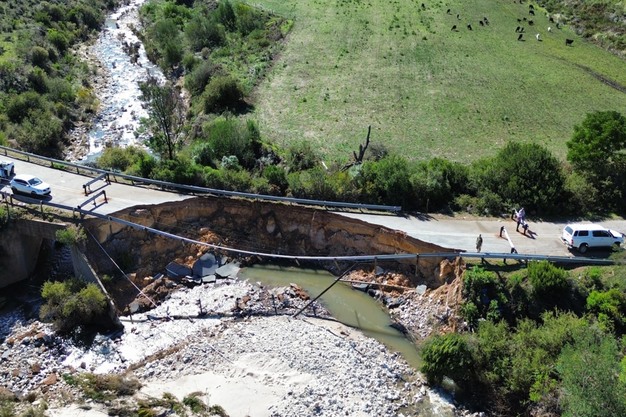
The gouged R62 cuts off residents from provincial medical services and disrupts the flow of food from Port Elizabeth (Gqeberha)
More than 10 hours to get a truck to the Langkloof due to severed road
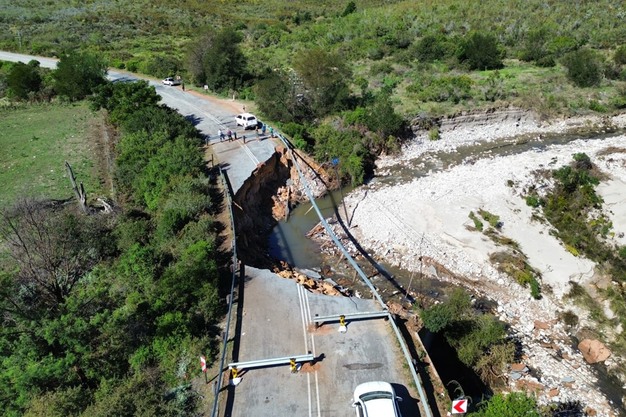
In the Langkloof, they have due reverence for rain, Kotze remarks – drought is no stranger to them. The tremendous rain left the Langkloof with one major headache: at a point between Joubertina and Kareedouw, the arterial road, the R62, has no road surface left. The gouged road cuts off residents from provincial medical services, and it disrupts the flow of fresh produce and other food supplies from Port Elizabeth.
Kotze accompanied the management of the Langkloof Agricultural Association on a visit to the site with the president and officials of Agri Eastern Cape and the roads agency’s engineers: a temporary bypass will need to be constructed alongside the R62, which requires major reconstruction.
In his years in the Langkloof, Kotze observes that it’s the first time the valley that runs from east to west is cut in two: the shortest route to the port of Gqeberha is no longer accessible. Flanked by mountain ranges on the north and south, the only other route has to skirt around the rugged peaks.
“It’s going to cost us a fair amount because containers to Port Elizabeth [Gqeberha] now need to go via George in the Western Cape – that’s an additional 600 kilometres. It now takes more than ten hours to get a truck to the Langkloof,” he explains. “Yet another additional cost from our pockets after an already difficult year – it’s not easy to bear all these costs.”
Many of the apples and pears grown here are packed for fixed programmes – those simply have to be supplied, Kotze says, or else an exporter loses market share and clients.
 © Dutoit Agri
“Containers from the Langkloof to Port Elizabeth [Gqeberha] now need to go via George in the Western Cape – that’s an additional 600 kilometres.”
 For more information:
Johan Kotze
Dutoit Agri
Tel: +27 23 312 3136
Email: [email protected]
https://www.dutoit.com/

Source: The Plantations International Agroforestry Group of Companies