The Moroccan watermelon season, which began in April in the Zagora region, faced market challenges from the outset, leading to a drop in prices. Said Aghzou, an exporter and CEO of Valyour, shares his perspective.
The exporter states: “Moroccan watermelons entered the European market while it was still flooded with large volumes at the end of the Mauritanian season. Prices were low at that time despite strong demand. We nevertheless managed to secure good prices during the first two weeks of the season.”
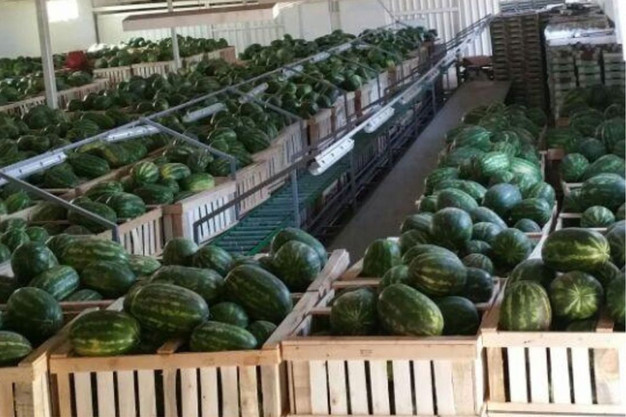 © Youness Bensaid | FreshPlaza.com
“Other factors then had a major impact on the market. On the one hand, Mauritanian watermelons continued to be exported in large quantities to European markets later in the season than usual. At the same time, the entire harvest from the Zagora region ripened all at once, and the market was also flooded with Moroccan supply. Prices therefore collapsed, falling as low as 40 euro cents,” Aghzou continues.
In addition to oversupply, the Zagora region produced mainly medium-sized watermelons this season, which Aghzou attributes to a colder-than-usual climate, further contributing to the decline in prices.
As a result, several exporters found themselves who sourced watermelons at high prices found themselves in financial difficulties, according to the Aghzou. “This prompted several exporters to ship poor-quality watermelons, which I saw for myself during visits to international markets in the Netherlands, Germany, and Spain.”
With the end of the Zagora cycle and the Mauritanian harvest, Moroccan exporters hope to get back on their feet by next week. According to Mr. Aghzou, certain positive indicators give cause for optimism: “We anticipate strong demand linked to Eid al-Adha, which boosts watermelon consumption among Maghreban and Turkish diaspora in Europe and coincides with the onset of hot weather. We expect prices to range between 70 and 90 cents.”
“For this sales period, we are focusing on watermelons from Taroudant, Chichaoua, and Kariat Ba Mhamed, renowned for their large size and superior quality,” Aghzou continues.
Competition will weigh on prices, as several origins are present on the market. “The Egyptians are there and have planted a variety similar to those grown in Morocco to target the European market. There’s also Spain and Italy, and perhaps Greece starting next week,” Aghzou concludes.
Moroccan producers can, however, count on a local market where demand for watermelons remains strong, and which is still awaiting the first large-sized watermelons of the season.
For more information:
Said Aghzou
Valyour
Tel: +212 6615 52683
Email: [email protected]

Source: The Plantations International Agroforestry Group of Companies