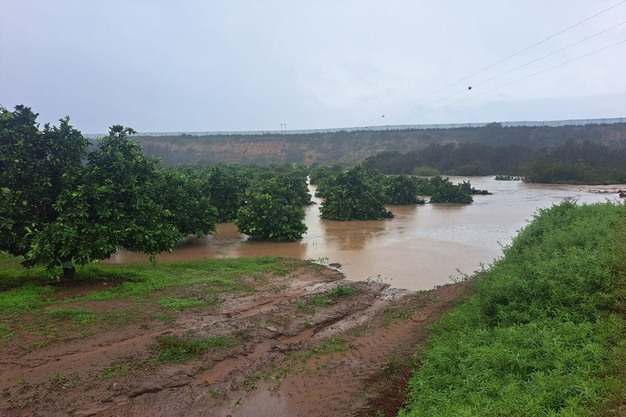
 © Carolize Jansen | FreshPlaza.comAcross the Western Cape, schools are closed today after two cold fronts racing in, hot on the heels of the severe cutoff low that caused devastation last week in the Gamtoos Valley, Eastern Cape.
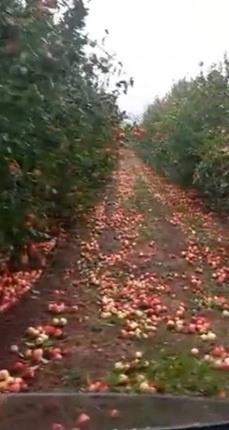
Right: screenshot of video purportedly taken in a Grabouw apple orchard
Due to high wind speeds, flights to Cape Town had to divert yesterday to Gqeberha and Durban. On land, tens of thousands of inhabitants in low-lying areas and within riparian flood zones are displaced.
Citrusdal and Worcester are cut off from the outside world. Tremendous amounts of rain fell – Newlands cricket stadium is underwater – and in the port of Cape Town, wind speed of 120km/h was allegedly measured.
The extent of damage is becoming clear as floodwater retreats. In the aftermath, videos circulate of drivers dodging fallen branches, the ground in a Grabouw orchard densely stippled with fallen apples, street after street of historic oak flattened in Swellendam. The damage appears to have been very widespread: from citrus orchards in the Cederberg to avocado orchards in the Southern Cape, and beyond, as reported last week.
Meanwhile, the largest dam in the province, the Theewaterskloof Dam, filled up by 15% in a week.
Packhouses are running to pack away the fruit picked before the floods. It’s getting the fruit out to the port that might prove problematic. Several Western Cape mountain passes, as well as the Huguenot Tunnel leading into Cape Town, are closed due to mudslides and flooding.
Flood and wind damage follow a band along the coast, taking in the Garden Route. In the Gamtoos Valley, citrus farmers hope to be back on track by next Monday.
In January, northeastern South Africa and Mozambique were under miles of water; now, the opposite end of the country is a flood zone. In the central plain, the country’s grain basket, unharvested peanuts have started sprouting in the constantly moist soil, and maize farmers are struggling to get into sodden fields.
 © Carolize Jansen | FreshPlaza.com
Low flood risk in lower Orange River
The northern Cape is the wettest it has been in 70 years, says meteorologist Johan van den Berg – some in the district say 80 years. They’ve recently received a casual almost 100 millimetres when their rain season ought to have ended.
Last year, almost to the day, the level of the Orange River was roughly 1.5m higher than it currently is, with a much higher risk for flooding than this year, grape growers are relieved to note.
The Kuruman River last ran in full flood in 1988; this year it burst forth (and a video circulated of springboks swimming across it). Even in the Kalahari, says an Orange River grape farmer, farmers are starting to balk at the amounts of rain.
The La Niña part of the cycle continued for longer than was predicted, remarks meteorologist Van den Berg, and the rest of the winter is likely to bring more unsettled weather than the norm.

Source: The Plantations International Agroforestry Group of Companies