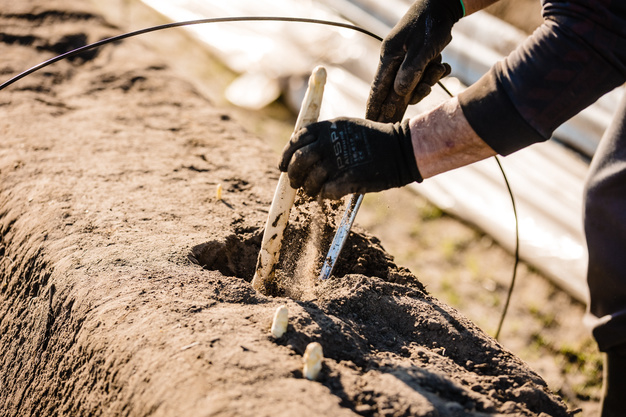
“This season, the asparagus market is progressing more or less according to plan, though supply and demand aren’t yet entirely in balance,” begins Will Teeuwen, director of the Dutch asparagus farm, Teboza. Spring came early, and while production fell short of expectations due to the fickle weather, demand actually picked up.
 © Teboza
“It seemed we might be able to offer volumes earlier, thanks to a few nice weeks in February and March. But the weather became unpredictable again, with cold nights, so, heading into Easter, volumes were somewhat disappointing after all.” Will notes that while market prices are good, supply has, so far, been lagging. “It looks like the weather is set to hold up from now on,” he says.
“Demand is rising considerably, and volumes are increasing. Those, however, still don’t quite meet demand.” It is likely to keep getting warmer, and Will expects production to increase further. “From now on, the improved weather will lead to a further increase in available volumes. That’s great, so we’re certainly not dissatisfied. Volumes should be good for this time of year,” he notes.
Chain integration is an advantage
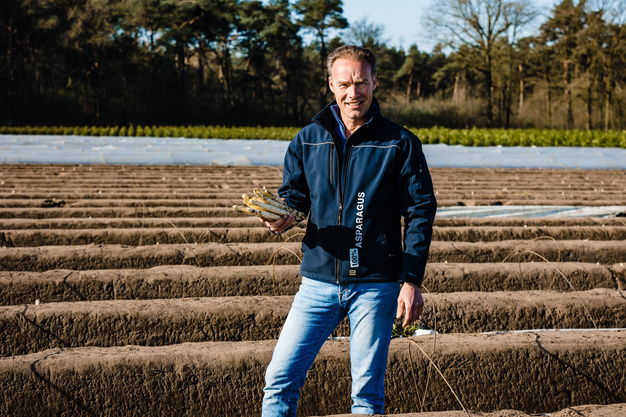
Teboza deliberately positions itself as a supply chain player, from plant stock to consumer. According to Will, that especially benefits practical day-to-day operations. “You know the entire chain, from what’s on people’s plates to what’s happening with growers worldwide. Because you also deal in plants, you make contact with many growers both locally and abroad. That’s when you hear about all kinds of things: the challenges, the problems.”
The company translates this information straight into its commercial operations. “Since you deal directly with customers, you can tackle their challenges more quickly. I think we’re good at that. We can respond more effectively to the market, client demand, and the challenges that arise,” says Teeuwen, adding that this is also where Teboza’s competitive edge lies.
 © Teboza
In the asparagus sector, scale is becoming increasingly important, Will points out. Not as an end in itself, but as a necessary investment base. “It’s so important that it basically determines your viability. The investments are becoming ever larger, too. When we talk about robotization and AI sorting machines, there’s so much money involved, you can only justify it with sufficient scale.”
You need that scale to maintain flexibility toward retailers. “You must invest to keep offering buyers speed and flexibility. For us to keep doing what we’re doing in retail, scale is indispensable,” Will explains. Packaging lines and processing capacity are also big-ticket items. “Those simply demand huge sums. You really need scale for that.”
Mechanized weed control on the rise
Teboza is also investing significantly in mechanization and cultivation innovation, and the sector is increasingly moving away from chemical agents. “We spend a lot on mechanization within the cultivation process itself, and no longer spray for weeds. We do that entirely by machine,” Will continues. That development is partly due to the restrictions on crop protection products. “There are fewer and fewer of those available. We’ve been growing organic asparagus for 15, 16 years, and we’ve gained plenty of knowledge from that.”
They are now applying that know-how more broadly. “We used that organic cultivation as a way to try and find a sustainable solution for our conventional cultivation, too. That worked out well,” Will reckons. That approach extends beyond the Netherlands. “We do the same at our overseas sites and work the same, using the same machines and methods in Spain as in the Netherlands.” That uniformity makes it easier to scale up innovations quickly. “What we develop here, we can implement, unchanged, there,” he points out.
Shift overseas
According to the director, asparagus demand in Europe is stable, while acreage has been shrinking for years. That creates a systemic imbalance between supply and demand. “The declining acreage isn’t so much due to demand. We’re facing a structural situation where there’s less supply.” The composition of that demand is changing too. Green asparagus, in particular, is gaining ground.
“Five years ago, we grew maybe five percent green asparagus; now it’s at 40% plus. That’s a significant shift in a relatively short time,” says Will. There are several reasons for that increase. “It’s easier to trade green asparagus internationally year-round. And health trends play a role. Green asparagus fits better into that picture.” Demographics, too, are a factor. “A multicultural society is less familiar with white asparagus, and green asparagus is more widely accepted,” he explains.
Teboza’s sales are heavily retail-driven. “That sector accounts for about 70%, food service for around 30. Retail clearly plays the biggest role.” According to Will, the greatest opportunities lie not in new product concepts, but in supply reliability. “You must be able to cope with climate change, economic conditions, and changing legislation,” he says.
The company thus focuses on shoring up its crops against the fickle weather conditions caused by climate change. “We try to farm in a way that allows for greater control of a stable supply. It’s vital that you can continue delivering. Product reliability and availability, that’s what it’s all about.”
 © Teboza
From the Netherlands to Southern Europe
A clear strategic shift is their relocation of white asparagus cultivation to Southern Europe. “We’re phasing out heated cultivation in the Netherlands, and focusing on expanding our acreage abroad,” says the asparagus expert. That is down to both economic and sustainability factors. “With energy prices and climate conditions being what they are, it’s irresponsible to grow heated asparagus in the Netherlands in February.”
Here, Spain is central. “There, we can harvest from February to October using various, electricity-free methods and techniques,” Will explains. Italy is also being explored. “We see potential there as well.” He expects this shift to continue. “I think that within four to five years, we’ll have roughly the same acreage in Spain as in the Netherlands, though the focus there will be more on green asparagus and in the Netherlands on white.”
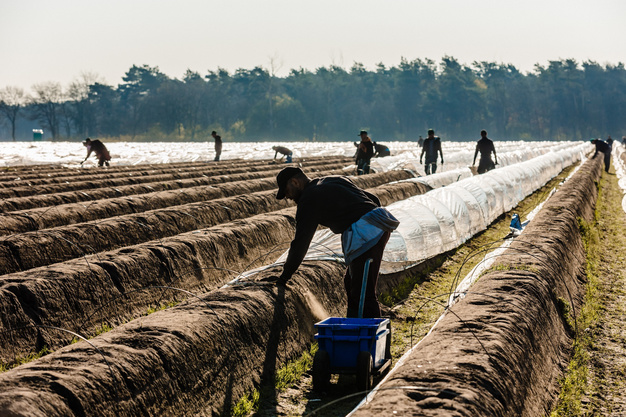
Despite all the technological developments, labor remains the sector’s biggest headache. “The main challenge is securing enough good staff. Also, regulations are constantly changing, and labor costs have skyrocketed,” Will points out. That cost increase is substantial. “In four, five years, you’re looking at an €8/hr increase. That’s absurd. For many companies, it’s nearly impossible to keep up.” According to him, this partly explains the sector’s scale expansion. “That’s hard to translate into actual profitability,” Will notes.
 © Teboza
Mechanical harvesting and developing AI
He says Teboza is currently testing various mechanical harvesting systems. “That ranges from harvesting aids that make the job easier for pickers to fully automatic harvesting robots, and everything in between.” The company wants to make a decision soon.
“We hope to draw serious conclusions next year. Then we’ll know: this is the system we’ll be using for the next five to ten years,” says Teeuwen, who also expects AI to become increasingly important. “I think that will play a bigger role in harvesting, sorting, and packaging. That development is moving fast.”
There is a clear urgency, says Will, for costs to come down, mainly by reducing labor. “That makes up more than 60% of the costs. That must decrease to maintain affordability,” he points out. That is why there is a broad focus on automation. “We must use mechanization, AI, and support to reduce those labor costs.”
Pride and the future
Despite all these challenges, Will is, first and foremost, proud of his company. “We’re doing well in every area. Good people, satisfied customers, good Dutch and Spanish cultivation. Everything fits perfectly together,” Will says. For the next five to ten years, he foresees further scaling up and technological acceleration.
“Companies are getting bigger, and some are disappearing without successors. And AI is going to play a bigger role in our sector.” He thinks one thing remains crucial. “Above all, the sector must keep costs under control. That will be the defining challenge for the coming years,” Will concludes.
For more information:
Teboza
Zandberg 14B
5988 NW Helden
Tel: +31 (0) 77 307 14 44
[email protected]
www.teboza.nl
Source: The Plantations International Agroforestry Group of Companies