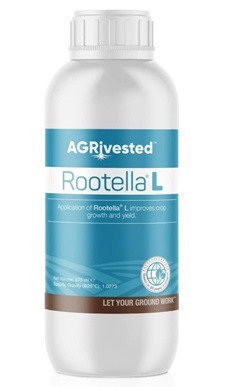
 © AgrivesteBioAgThe uncertainty cast over fertiliser supply and costs by the war in the Middle East underlines the importance of using other life forms present in soil before plants even have roots. “Mycorrhizae unlock the unavailable phosphorus, micronutrients, zinc, minerals locked up after years of synthetic fertilisation, and make them readily available to plants,” explains Chad Miller of the Rootella mycorrhizal inoculant developed by GroundworksBioAg.
It is applied to seeds, in-furrow and through the irrigation, significantly boosting the growth of young saplings, Miller says, as well as to tree crops and annual crops like soya, maize, sunflower, sugarcane, perennial and orchards.
“What makes mycorrhizal fungi so pertinent now is the high diesel prices and high fertiliser prices because of the war. Mycorrhizal fungi essentially allow the farmer to either minimise their phosphorus fertilisers by up to 50% per hectare or use the bare minimum with which they feel comfortable.”
The reduction in spending on chemical fertilisers, specifically phosphorus additions, is bolstered by decreased movement of spray cars and tractors around the farm, probably requiring diesel.
The merits of mycorrhizae and the principles of their workings are well-known to South African farmers. Before plants had roots, they found everything they needed through the fungal highway, Miller remarks. Different species of mycorrhizal fungi are not equally valuable or efficient.
Rootella inoculant contains the arbuscular mycorrhizal species Glomus mosseae and Glomus intraradices, sourced from the desert. “Our spores are a lot hardier because it’s sourced from the desert and excel in harsh arid environments and suboptimal soils. Rootella is compatible with 95% of all soil and crop types and helps crops thrive in extreme abiotic conditions, extreme drought, and heavy rainfall. It’s had to become over time a stronger, hardier spore. It absolutely thrives in arid, harsh environments.”
These AMF fungi species, living inside plant cells, cohabitate with ectomycorrhizae, fungal partners outside the plant in the soil. “It means in the beginning stages of the plants, you get the additional phosphorus up to the tree, and then in the later stages of its life, the ectomycorrhizae would then be more responsible for the nitrogen up to the tree.”
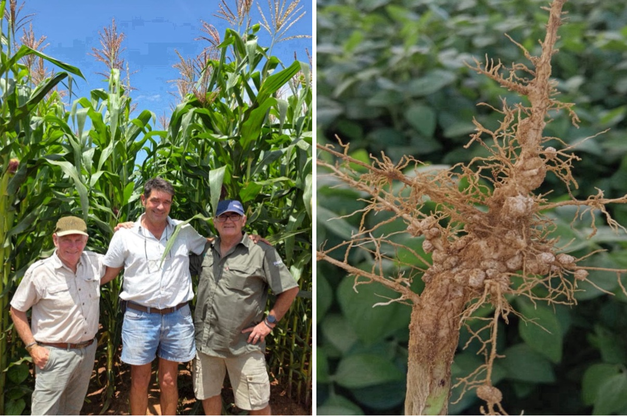 © AgrivestedBioAg Rootella applied to maize seed planted 60 days prior, right, nodules developed on Rootella-treated soyabean plant
Rootella’s high concentration is distinctive
Mycorrhizal inoculants are measured in units called spores, which contain not only the viable spore but also its associated living root fragments and hyphae(propagules) to help the fungus survive and re-awaken upon contact with plant root exudates.
“Our product is 167,000 propagules per gramme/ml, which is 50,400 viable spores per ml. It’s by far the most concentrated mycorrhizal inoculant globally on the market.”
Rootella’s high spore concentration ensures an over-abundance of viable propagules, helping to counteract potential attrition caused by fungicide applications. Despite this, Rootella mycorrhizae remains highly compatible with approximately 85% of commonly used fungicides, pesticides, and insecticides. This means that even under chemical application conditions, multiple spores per seed or crop are able to survive and successfully establish symbiosis.
To support decision-making, Rootella’s compatibility tool enables production managers to assess whether Rootella will remain viable when used alongside specific crop protection products. “Rootella is compatible with 85% of all herbicides, fungicides, insecticides, pesticides – and it’s compatible with glyphosate, which most other mycorrhizae products aren’t.”
For more information: Chad Miller
AgrivestedBioAg
Tel: +27 82 452 347
Email: [email protected]
https://www.agrivested.com/

Source: The Plantations International Agroforestry Group of Companies