Specialty crop producers in California are increasing investments in automation as labor costs and regulatory compliance expenses continue to rise.
At Sierra Gold Nurseries in Yuba City, a nursery supplying trees for crops including almonds and apples, labor accounts for approximately 60% of input costs. The company employs more than 300 workers during peak periods and has introduced automated systems to reduce manual labor requirements.
According to Sierra Gold, a robotic transplanting system has replaced a potting line that previously required 12 workers. The nursery has also deployed autonomous shuttles to transport plants across its 26-hectare facility.
“We’ve implemented a lot more automation,” said Josh Puckett, vice president of operations at Sierra Gold.
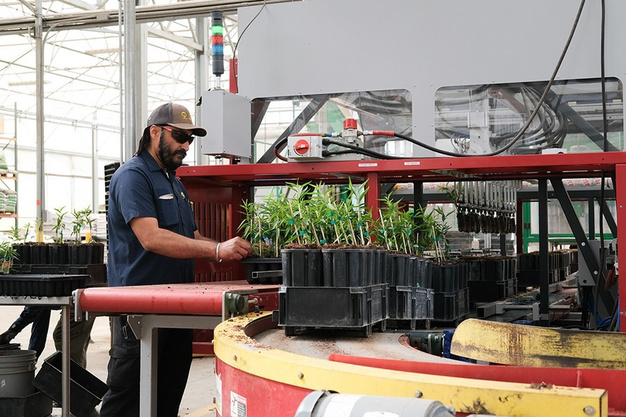 © Caleb Hampton/AgAlert
Industry participants point to rising labor costs as a driver of technology adoption. Since 2016, California’s minimum wage has increased by 40%, while agricultural overtime regulations have increased labor expenses or reduced working hours in some operations.
Research conducted by Cal Poly, San Luis Obispo found that regulatory compliance costs for California lettuce growers increased by 64% between 2017 and 2024. According to the study, labor-related regulations accounted for much of the increase.
“Both hit us at once,” Puckett said, referring to minimum wage and overtime legislation.
Growers in other specialty crop sectors are also increasing mechanisation. Yolo County tomato grower Bruce Rominger said he purchased a robotic tomato transplanter in 2024 that reduced planting crews from 30 workers to four employees.
California wine grape growers have also expanded the use of mechanised pruning, leaf removal, and harvesting systems. According to industry representatives, autonomous sprayers, self-propelled harvest platforms, optical sorting equipment, and laser weeders are becoming more widely used across specialty crop production.
Despite increased automation, industry researchers and growers said farm labour remains essential, particularly for fresh produce harvesting.
Stavros Vougioukas, an agricultural robotics researcher at the University of California, Davis, said that “for the foreseeable future,” robotic systems will not match workers in harvesting fruit from within crop canopies without causing damage.
Growers also cited barriers to automation adoption, including investment costs and regulations governing driverless farm equipment.
At Sierra Gold, automation has also altered workforce requirements. Employees who previously carried out manual potting tasks have been trained to operate and manage automated equipment.
Industry participants noted that demographic changes within the agricultural workforce are also contributing to increased interest in automation and technical roles within farming operations.
For more information:
AgAlert
Tel: +1 916 561 4507
Email: [email protected]
www.agalert.com

Source: The Plantations International Agroforestry Group of Companies