Amid the devastation caused ten days ago by engorged rivers cleaving through Western Cape orchards and fields, there is at least the consolation that this year’s onion crop escaped unharmed, says Cathrine Smuts, the general manager of De Keur Marketing, a grower-exporter in Ceres. “The onions had already been harvested, so we have suffered no losses in that respect.”
The longday brown onions for which the Koue Bokkeveld is renowned were safe in bins and cold rooms and busy being packed. “Currently, we’re only packing onions for the domestic market. Our area, the Ceres and Koue Bokkeveld area, grows onions on approximately 2,400 hectares, supplying roughly 175,000 tonnes of onions.”
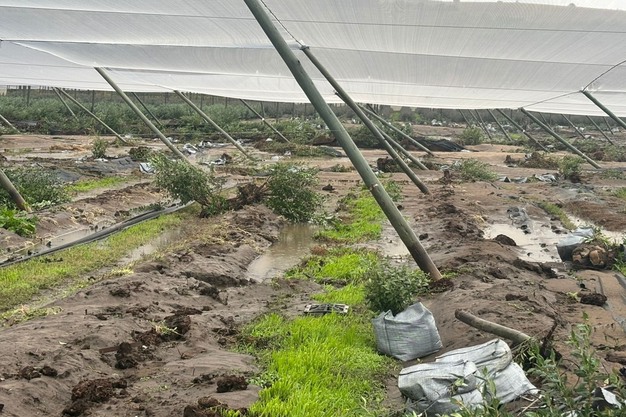
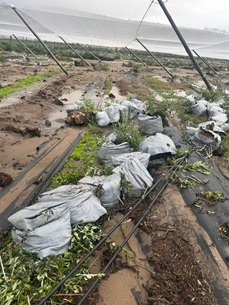 © De Keur MarketingHowever, the torrents of water caused major damage in their destructive rush through topfruit and stonefruit orchards. “We’ve sustained significant infrastructural damage to our roads on the farms and to farm dams. In Ceres and Wolseley, where the Breede River breached its banks, the area is looking at deep gullies washed out in the orchards.”
Right: flood waters created havoc with blueberry pots
In the greater Wolseley district along the Breede River – aptly named: broad river – there are orchards that cannot be replanted due to the extensive erosion caused by the floods.
De Keur’s covered blueberry net houses and tunnels bore the brunt as new streams formed and water carved out the quickest path. “Infrastructure like nets, poles, pump houses, and bridges will have to be repaired or replaced. Some of the plants, especially those situated close to the riverbank, have been completely washed away.”
The Western Cape government has estimated that a total of 400 roads across the province were affected by last week’s storm, in which numerous homes sustained heavy damage.
The area has been partly without electricity since the storm on 10 May. Smuts remarks that it costs millions in diesel, of which the price recently increased in response to the Middle East situation, to keep packhouses and cold rooms running on generators. Electricity in Ceres has been repaired and is running on a loadshedding schedule for the moment.
“In some areas, potable water for human and animal consumption as well as for irrigation is still a challenge,” she concludes.
 © De Keur Marketing
 For more information:
Cathrine Smuts
De Keur Marketing
Tel: +27 23 315 5605
Email: [email protected]

Source: The Plantations International Agroforestry Group of Companies