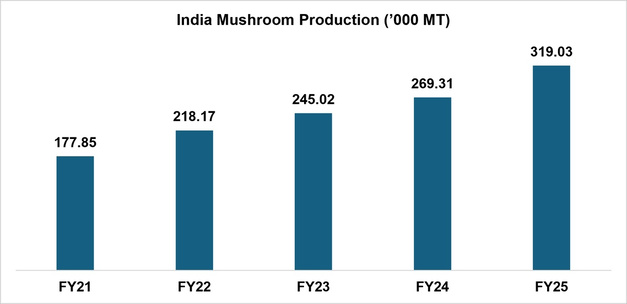
India’s mushroom harvest increased by 79.4% over five years, rising from 177,850 tons in FY21 to 319,030 tons in FY25. The expansion has been supported by government assistance, relatively low cultivation costs, and demand for mushrooms as a food source.
Mushroom cultivation requires limited land and short growing cycles, while agricultural residues such as paddy straw and sawdust can be used as substrates. Cultivation has expanded beyond the states where the sector was previously concentrated.
Under the Mission for Integrated Development of Horticulture (MIDH), growers can access financial and technical assistance for cultivation infrastructure, spawn facilities, and compost units. Revised 2025 guidelines provide 40% financial assistance for private-sector units and 50% for low-cost mushroom units, subject to specified limits. The program has also been extended to all districts, with updated cost norms and support for cultivation technologies.
 © India Brand Equity Foundation
State-level initiatives include Uttar Pradesh’s Rural Livelihood Mission and Odisha’s Mushroom and Floriculture Mission, which support mushroom cultivation among rural women and self-help groups.
The Agricultural Technology Management Agency (ATMA) provides ₹25,000 (US$282.90) per Farm Women’s Food Security Group for training, materials, and inputs. Female participation in ATMA programs increased from 993,000 beneficiaries in FY25 to 1.161 million in FY26, as of February 28, 2026.
Research and training programs are also supporting the sector. Under the Biotech-KISAN project, more than 5,000 women have received mushroom cultivation training, while 1,200 self-help groups have been established or supported.
The Indian Council of Agricultural Research’s Sustainable She-preneurship in Mushroom Cultivation Model (2S2M) provides training, access to resources, and market connections. Reported outcomes include mushroom cultivation incomes exceeding ₹100,000 (US$1,059.55), improvements in resource access of more than 35%, and reductions in manual labor of more than 37% through mechanized tools.
Infrastructure development has included the establishment of a mushroom spawn laboratory at ICAR-KVK Namsai in April 2026. Other research centers have expanded training in oyster mushroom cultivation, processing, and marketing.
In June 2026, researchers also met in Guwahati under the All India Coordinated Research Project on Mushrooms to discuss cultivation technologies and research developments.
For more information:
India Brand Equity Foundation
Tel: +91 11 43845501
Email: [email protected]
www.ibef.org
Source: The Plantations International Agroforestry Group of Companies