Ceres Fruit Growers represents more than 40 topfruit farmers and owns 50% of Tru-Cape Fruit Marketing, the largest exporter of South African pomefruit. Growing conditions are mixed, with a huge downpour of rain early in May and a very dry period for the rest of the winter period till now.
The early orchards are stirring, possibly slightly earlier than usual, but not wildly so. “Last year was an early season too,” observes De Kock Hamman, technical advisor at the grower-owned company. “We harvested the early BCs already in December of 2025, but we’re not crazy about an early year: it often means we struggle with fruit sizing and there’s no use getting into Europe too early with our fruit.”
This season’s rainfall tally includes the 488mm Ceres received on 10-13 May, causing huge infrastructural damage in the area and leaving the town with limited national electricity for 7 weeks. Most farm dams are full, and water supplies should be sufficient for the coming season, but this volatility—a deluge followed by months of below-average rainfall—is a cause for concern.
 © Ceres Fruit Growers
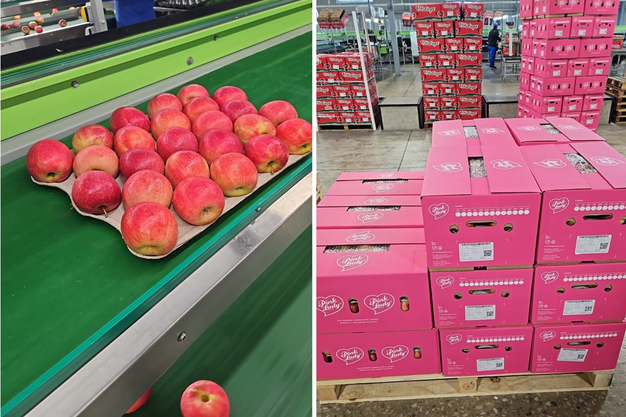
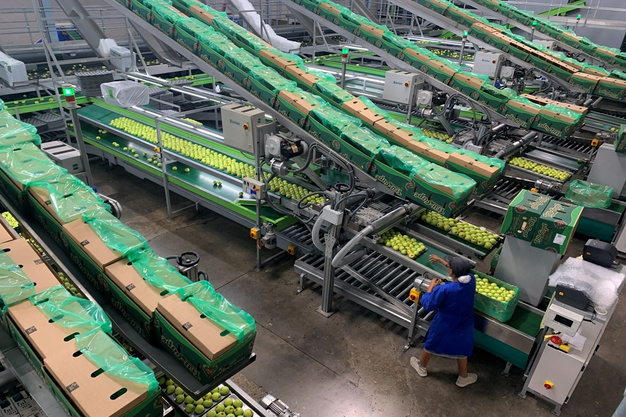
“Currently we’re right at the very end of the Pink Lady packing season, with a strong focus on Europe and the UK. Now we’ll be turning our attention to Cripps Red; we’re still packing Fujis for the Far East, and we’ll be sharpening our focus on Red apples and Golden Delicious,” says Frederick Odendaal, manager of Growers Direct@CFG. “During the main export season, the packing focus is more on your export cultivars with deadlines in terms of market access, especially before new season Northern Hemisphere fruit enters markets.”
Their industry revolves around the so-called world cultivars – those that you can sell anywhere – like the many Gala strains which Odendaal describes as a safe cultivar. “You want to finish packing Galas by week 32; otherwise, one competes with the Northern Hemisphere,” he explains – packing after this, the fruit will compete with the new season European and British apple crop.
Those markets are loyal to homegrown apples, and most Supermarkets won’t switch over to new season Royal Galas from the Southern Hemisphere before their own product has been cleaned up.
 © Ceres Fruit Growers
Elimination of fruit tariff to China
Forelle is the pear equivalent of a global cultivar, and thrives in the Ceres area. India offers very good opportunities, including for its non-blushed variant, Vermont Beaut. In contrast, he characterizes Abate Fetel e as a Eurocentric cultivar; if Italy produces a good harvest, the marketing window shrinks significantly.
The former 10% tariff on South African topfruit to China is falling away – a very positive development, he remarks – but China has massive domestic production on apples and pears. “They have sufficient supply of the run-of-the-mill varieties, but they’re willing to pay for specific quality and sizes on specific cultivars.”
When China granted access for South African pears, they’d hoped the market would be interested in cultivars other than Forelle and early “blush” pears, such as Packham’s Triumph pears, for example.
Pomefruit exports have been more complicated than usual since week 10 and the start of the conflict in the Middle East. “The region is tremendously important, specifically on small bi-coloured summer pears, like Rosemarie, which we start picking in January. Getting to that market incurred much higher costs than usual, but it would have been disastrous to avoid that market and attempt to sell those pears into some other market.”
Inevitably, it was not possible to sell the same volume as previous years. “Product is still moving to the Middle East, via new routes and at much higher cost than before. These routes include one via Europe and the Suez Canal, which entails significant cost implications.”
 © Ceres Fruit Growers
For more information: Frederick Odendaal
Ceres Fruit Growers
Tel:+27 82 898 5822
Email: [email protected]
https://www.cfg.co.za/

Source: The Plantations International Agroforestry Group of Companies