Asia Fruit Logistica opened its doors in Hong Kong on Tuesday, September 2, with remarkable activity from Latin American exporters and trade associations looking to strengthen their presence in what remains widely regarded as the world’s highest-growth market for fresh produce.
 © Diana Sajami | FreshPlaza.com
Chile reinforces its commitment to diversification
At the Chilean stand, which has been very busy from day one, representatives of Frutas de Chile highlighted the continued importance of China for the country’s export volumes, while emphasizing the need to broaden their reach. According to Iván Marambio, China accounts for 87% of Chilean fruit shipments to Asia, but the association is actively working on the development of markets such as Vietnam and Indonesia, where phytosanitary protocols have recently been signed to facilitate access for new fruit. “Today, only 0.5% of all the fresh fruit exported by Chile abroad goes to Southeast Asia,” he said, so that’s exactly where they are aiming to grow.
 © Diana Sajami | FreshPlaza.com
Regarding cherries, Claudia Soler said that three trade agreements have been signed in the region in 2026, including those with Vietnam and Indonesia, opening the door to air freight shipments without the need for cold treatment. “Our main market is China,” she said, while also mentioning that non-Chinese markets grew by 26% in the last season.
The Kiwi Committee also reported a “very good” campaign, in the words of its president Carlos Cruzat, who said that Asia remains a developing market compared to Europe, which is already well established. “For now, the varieties we have are a little too sour for Chinese tastes. So we need to start working with new varieties to be able to reach China,” he said, referring to the Asian preference for sweeter fruit.
 © Diana Sajami | FreshPlaza.com
Peru: Blueberries and logistical challenges
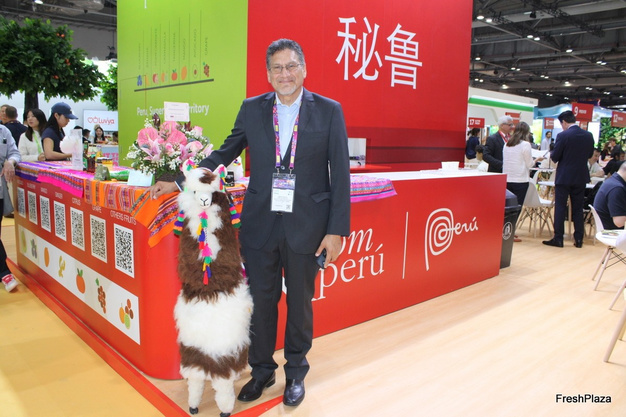
On the Peruvian side, AGAP and some major exporting companies highlighted Asia’s growing importance as the country’s fourth-largest destination market, behind the United States, Europe, and Latin America. Gabriel Amaru, of AGAP, said that mango, blueberry, and avocado are Peru’s main products, and negotiations are currently underway for the country’s cherries to gain access to China. “The challenge is to open markets for crops in different areas across Asian countries, and to increase the volumes and production for Asia,” he said.
 © Diana Sajami | FreshPlaza.com
In the blueberry segment, representatives from Grupo Danper and Euroandes outlined their dual-mode strategy combining sea freight to Europe with air re-exports to Southeast Asia, with the aim of cutting transit times. “Today it is a potential market that is growing, and which has yet to reach its peak,” they said, pointing out that consumption still has significant room for growth in India, Thailand, and Singapore.
Overall, the first day of the fair confirmed that, while China remains central, Latin American exporters agree that future growth lies in diversifying destinations across the Asian continent.

Source: The Plantations International Agroforestry Group of Companies