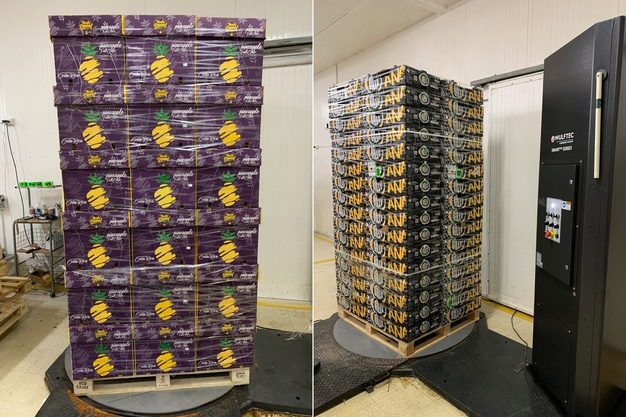
After testing a ventilating pallet wrap as an alternative to its previous corner board and strapping system, Costa Rican pineapple exporter Fertinyc has moved its entire export volume to the new packaging method. According to owner Wilberth Gómez Rojas, the change has brought improvements in pallet stability, packaging use, and packing efficiency, while also reducing damage and rejections at destination.
Fertinyc is a third-generation business with more than two decades of experience exporting pineapples. The company continues to grow fruit on the same land where it started and has its own agricultural biotechnology center, where it produces microorganisms and biofertilizers aimed at supporting soil health.
Wilberth says the company is continuously looking at ways to improve its operations, including the packing and export process. “We are always looking for opportunities to improve, not only in the field but also throughout the packing and export process,” he says. “As an organic grower, environmental is important to us and we believed it can go shoulder to shoulder with quality and commercial.”
 © Potentieel
From corner boards and straps to ventilating wrapping
Before introducing InnoVent®, Fertinyc secured its export pallets using corner boards and straps. While the system worked, Quesada says it required more manual labor and left customers with several different packaging materials to separate and recycle.
“Our main concern was always how the pallet arrived,” Wilberth explains. “We wanted greater confidence that the pallet would remain stable and that both the fruit and the packaging would reach the customer in the condition we expected.”
The company decided to test InnoVent after seeing the potential for a more efficient packing process. “We are always looking for ways to improve the packing shed. We evaluate every step and ask ourselves how we can make the process more efficient,” he says. “When we saw InnoVent, we thought it could be a very interesting opportunity.”
Ventilation was another consideration in the decision. According to Wilberth, airflow around the fruit is important during long-distance transportation because pineapples continue to respire, including through the crown.
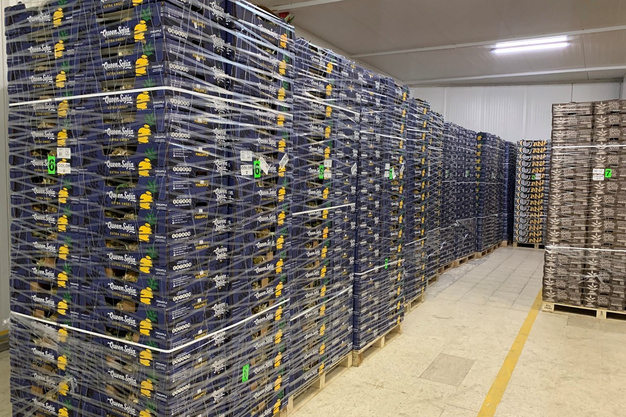
“For us, airflow around the fruit is therefore very important. We need packaging that can hold the pallet together without unnecessarily restricting ventilation,” he says. “That was one of the things we liked about InnoVent. Its open structure allows air to circulate around the pallet while still providing secure load containment during handling and transportation.”
 © Potentieel
Testing the system through the supply chain
The initial trial gave Fertinyc the confidence to continue with the system, but Wilberth says the company’s evaluation did not stop at the packing shed. He travelled to Europe to see the pallets after they had completed the export journey.
“The condition was perfect,” he says. “The pallets were straight, stable and well presented. We also saw fewer damaged boxes and a significant reduction in rejections.”
For Wilberth, seeing the pallets at destination was an important part of the evaluation. “We were not only evaluating what happened in our packing shed. We were seeing the result after the complete export journey, and the benefit to our customers and partners overseas.”
He describes the difference in pallet stability in straightforward terms. “I like to describe it very simply: the pallets arrive like a straight building. They stay aligned rather than shifting during the journey.”
According to Wilberth, Fertinyc has seen benefits in several areas, including pallet stability, damage, packaging waste, and rejections.
Faster wrapping and less packaging material
The change has also affected the operation inside the packing facility. Wilberth says the wrapping process is faster than the previous system and requires fewer labor resources. “In our application, we use approximately 150 grams of wrapping material per pallet,” he says. “That means we are putting less packaging material into the supply chain, while at the same time achieving the stability we need.”
For the exporter, operational efficiency is not simply a matter of reducing the amount of packaging used. “It is about finding a solution that works operationally and also performs throughout transportation,” Quesada explains.
The company also sees a difference from the customer’s perspective, with fewer packaging components to handle after delivery. “There is less material to manage after delivery, and at the same time, the pallet reaches them in better condition,” he says.
Full export volume
Following the trial, Fertinyc decided to extend the system across its export operation. “Today, 100% of our export volume is shipped using InnoVent pallet wrap,” Wilberth says. “We started with a trial, evaluated the results both in our operation and at destination, and based on what we saw, we decided to move our full export volume to the solution.”
Wilberth says the combination of ventilation and load stability has been particularly relevant for the company’s long-distance pineapple shipments. “Every exporter has to evaluate the solution in its own operation, but based on our experience, the combination of ventilation, stability and operational efficiency has worked very well for us,” he says. “In fresh produce, you need the product to breathe, but you also need the pallet to remain stable throughout a long export journey. For us, InnoVent delivers both.”
For more information:
Wilberth Gomez
Fertinyc
Tel: +506 6172 1269
Tama Pallet Wraps
tama-pallet-wraps.com
Source: The Plantations International Agroforestry Group of Companies