At an altitude of more than 1,100 metres, not far from Yerevan, Agro Prom grows tomatoes on 10 hectares of high-tech greenhouse. Owner Hayk Hunanyan, whose group made its name in construction, had never grown a tomato before last year. Today his Armenian company ships them by its own refrigerated trucks to Europe and the Middle East, even in August. He explains how sun, cold well water and an AI robot named Luna help him do it, and why Armenia’s small home market hardly matters.
From concrete to tomatoes
Agro Prom is part of Prom Group, which is active in several sectors in Armenia. “We own one of the biggest construction companies in the country, and we have built greenhouses for other companies,” says Hayk Hunanyan. “But we had never grown tomatoes ourselves.” Building for others was the start of something bigger. “We knew how a greenhouse works, so we decided to do it on our own.”
 © FreshPlaza
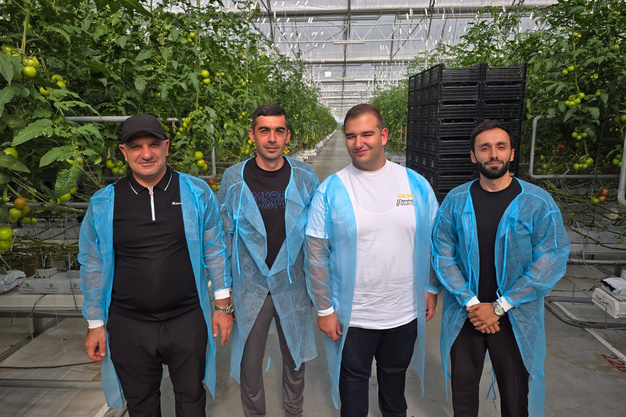
From left to right: Hayk Hunanyan (owner of Agro Prom), Housep Suvanyan (agronomist), Sargis Hunanyan (the son of Hayk), and Gevorg Alavendyan (CEO).
Sun, water and isolation
Before choosing a site, the company did its own research. Three things decided it. “First, the sun radiation is very high here,” says Hunanyan. The greenhouse stands at 1,100 to 1,150 metres above sea level, which may also help keep diseases down.
The second factor is water. “There are large underground reserves, so we drilled our own well of 350 metres.” The water is filtered and set to a very specific EC and pH for tomatoes. It comes out cold, at 14 to 15 °C, and is also used for cooling in summer.
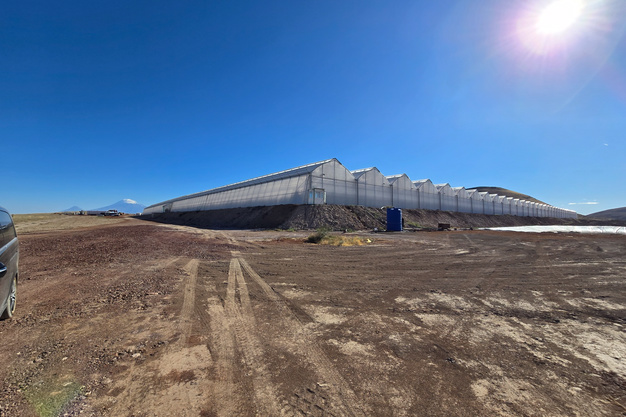
The third is isolation. “This area is about 400 hectares and there are no other greenhouses around us. So the disease pressure is very low.”
Starting big
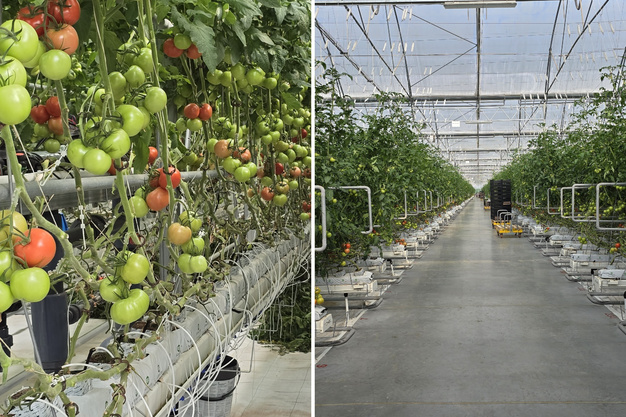
Agro Prom began with 10 hectares and no client lined up. “We wanted to build a serious greenhouse and have a strong team of specialists,” Hunanyan says. “With 10 hectares you get big harvests and a good position with buyers.”
 © FreshPlaza
Help from the state
The government subsidises interest on new greenhouses. “The total interest rate is 14%. The government pays 8% and we pay 6%.” How much the state pays depends on the investment. “Smaller projects get more support, larger ones less.”
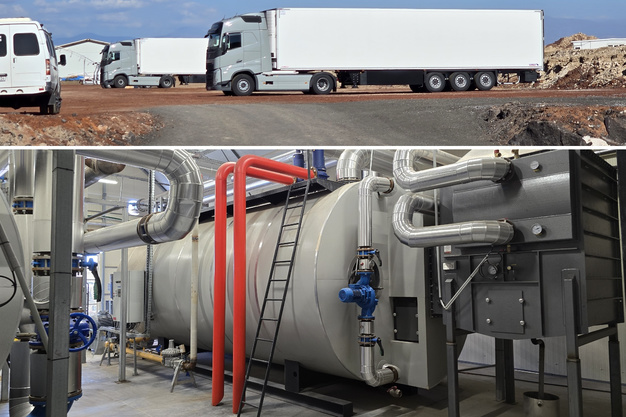
The company also invested in transport. “We have 20 Volvo trucks with refrigerated Schmitz Cargobull trailers. It keeps transport in our own hands, and we plan to buy 30 more.” The trucks do double duty. “On the way back from Europe they bring fertilisers and other goods, also for other companies.” After each trip they pass through a fumigation system.
 © FreshPlaza
The company owns 20 Volvo trucks with refrigerated Schmitz Cargobull trailers; the machine room is brand new.
A second 10-hectare greenhouse is planned, for red, green and orange bell peppers, meant for Europe and the Middle East. The site has secured 19 megawatts of electricity from a nuclear power station.
One crop, one year
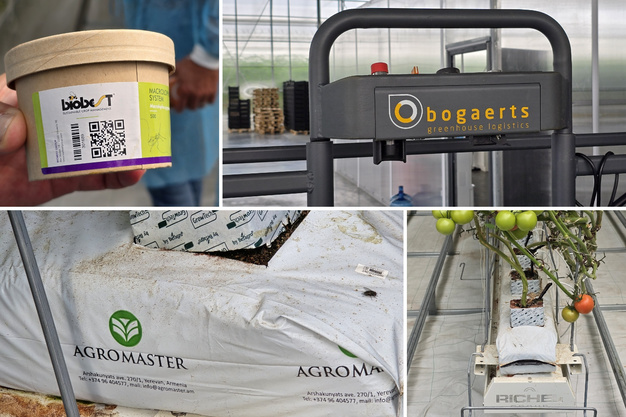
The greenhouse currently grows tomatoes on the vine of around 180 grams each. All seeds come from Bayer. “They are resistant to ToBRFV, although we don’t have the virus here. We chose varieties that produce all year, so no separate winter and summer varieties.” The plants grow in coco peat from Sri Lanka.
The greenhouse was planted last October. “The first harvest came 110 days after planting. Then we harvest for about 240 days.” After that the crop is removed. “Then the whole greenhouse is cleaned by fumigation, to get rid of viruses and insects.”
 © FreshPlaza
Agro Prom works with Armenian and Western European suppliers.
Daily output is now 18 to 20 tonnes. “With artificial lighting we expect 75 kilos per square metre per year. On 10 hectares, that is about 7,500 tonnes.”
Winter cold, summer heat
Winters can bring -20 °C. The greenhouse uses gas heating and LED lighting. “There is sunshine in winter, but the radiation amount is not enough for tomatoes.” A screen keeps the light inside. The structure is high on purpose. “That helps us control temperature and humidity, which matters for plant health.” Heating pipes melt snow on the roof quickly.
In summer it can reach 40 °C outside. “We use fogging, special paint on the roof, windows that open and close, and the cold well water. Inside, it never gets above 28 °C.” Carbon dioxide comes from a separate gas burner in the boiler room. “We don’t lose it. Actually, we are reusing it.”
Exporting first
The first tomatoes went to Ukraine. Since then the company has shipped to Italy, Germany, Latvia, Spain, Romania and Bulgaria, and to the Emirates, Oman and Qatar. “I don’t see a big difference in difficulty between the Middle East and Europe.”
The home market is no priority. “The local market is very little,” he says. Armenia has around three million people, many greenhouses, and in summer plenty of home gardens. “We sell into Europe even in August.”
Prices follow the weather
Agro Prom does not deal with retailers directly in Europe. “We work with a trader who supplies the big retailers. When we have 50 hectares of greenhouse, they will be interested in our tomatoes.” In the Middle East the company has direct contacts as well as traders.
 © FreshPlaza
The area covers about 400 hectares and there are no greenhouse neighbours. Disease pressure is therefore very low.
Prices are climbing. “They rose around 35% between August and September. Home gardens and open-field growers are finishing their season. Now the cold season is coming, so demand for our tomatoes will be high.”
For now everything is shipped as white label or private label. “We will launch our own brand in the very close future. We have a few names in mind, and we want one that Europeans understand easily.”
A robot and a human team
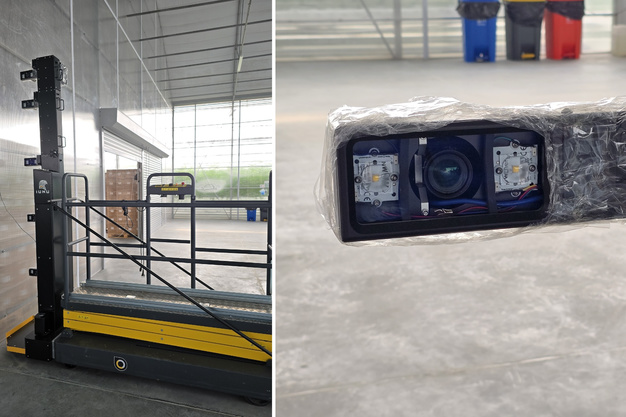
Agro Prom uses LUNA, an AI platform by IUNU. A robot drives through the greenhouse on its own and scans the plants, tracking tomato weight, ripeness, pests and plant health. Yet people keep watching too. “We compare the two,” says Hunanyan, “because the human cannot see everything the robot would see, and vice versa.”
 © FreshPlaza
Agro Prom uses the AI platform LUNA by IUNU for monitoring and management of the cultivation. The autonomously operating robot scans the greenhouse and the plants, tracking total tomato weight, ripeness, pest pressure, plant health.
Traceability is tight. “Every pallet has its own number, so if there is a problem we can trace it to a specific pallet and box”, Hunanyan concludes. The company is GlobalG.A.P. certified.
For more information:
Hayk Hunanyan (owner)
Agro Prom
Nor Yedesia
Aragatsotn (Armenia)
Tel.: +374 93991154
[email protected]
www.promgroup.am

Source: The Plantations International Agroforestry Group of Companies