MushVision is looking for Dutch mushroom growers willing to test its AI system on an actual growing bed. Every day, in every growing room, the same checks are carried out. How is the crop developing? What will be ready for harvesting tomorrow? How many kilos can be committed for delivery this week? For an experienced grower, this is almost second nature. However, this knowledge is difficult to document, measure, and pass on to someone else. MushVision started with one question: how much of this can actually be measured?
Three people, one question
MushVision is being developed under the name Zivi Farms. Satyam Chaudhary came up with the idea and is leading the project. Kumud Hasija recently graduated in AI, while Dhruv Shah graduated from UPES. The team is based in India but is deliberately developing the system for Dutch growers. “The Netherlands is where this crop is grown to the highest standard, by growers who’ll tell you straight if something isn’t working. What we learn here, we can later take to smaller businesses, including those back home.”
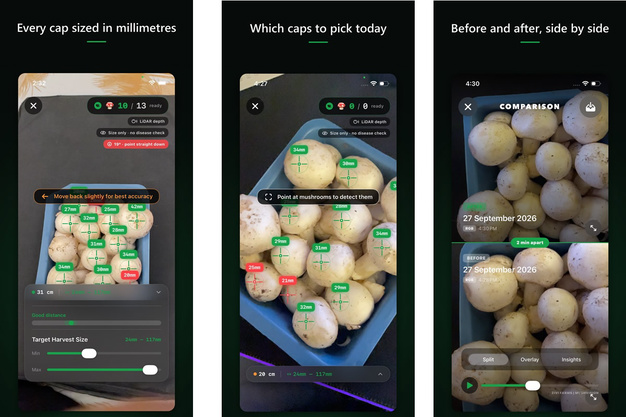
If a mushroom is picked too early, it will never reach its potential weight. If it is picked too late, its quality deteriorates. This decision is made hundreds of times an hour by people with varying levels of experience, and new pickers need months to consistently get it right. A grower visually assesses a growing bed. The system counts the mushrooms, measures their size, estimates their weight, forecasts development over the coming days, and flags those that require closer inspection. It performs these tasks consistently, regardless of who is on duty.
 © Zivi Farms
What the results show
In tests involving more than 70,000 mushrooms that were also counted and measured manually, the system detected approximately 98 out of every 100 mushroom caps. False detections occurred fewer than once in every thousand cases. Diameter measurements were within one to two millimetres of manual measurements, while estimated weight per bed was within approximately one to four per cent. The system also performed well on images from a second farm that had not been included in the development dataset. “The people who work on the beds every day know which figures are really useful. We’d rather hear that now than in two years’ time.”
The team is looking for Dutch growers willing to test the system on an actual growing bed and provide honest feedback about what does not work. The app is free to use, and a test takes approximately fifteen minutes. If growers identify missing features, the team will use their feedback to guide further development of the app. The team is also developing its own measuring device, aiming to create an affordable system that is accessible to smaller growing operations.
The app is available free of charge in the App Store
For more information:
Kumud Hasija
MushVision (Zivi Farms)
[email protected]
www.zivifarms.com

Source: The Plantations International Agroforestry Group of Companies