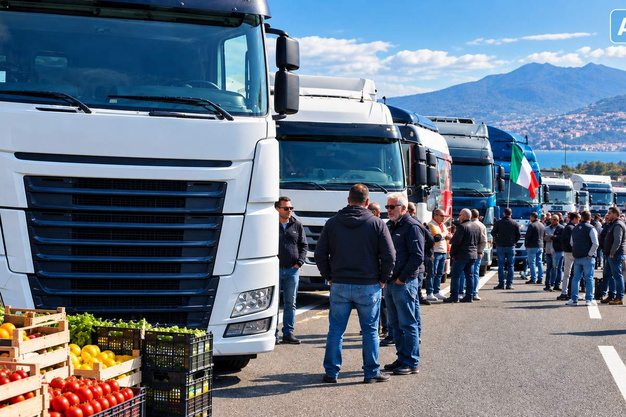
Despite the outcome of the institutional talks and the government’s allocation of financial resources to address rising fuel prices, the road haulage strike is causing a deep divide across the country. While traffic is continuing without systematic blockades in the North, in large parts of the South – particularly in Puglia, Calabria, Campania and Sicily – the logistics network is almost completely paralysed. This prolonged standstill is causing unacceptable food wastage and severe economic damage throughout the entire agri-food supply chain, from production in the fields right through to retail and catering outlets.
On the retail and consumer front, Federdistribuzione welcomes the solutions agreed at the Ministry of Infrastructure and Transport by Minister Matteo Salvini with the hauliers’ associations, but highlights a further worsening of the critical situation in the southern regions. President Carlo Alberto Buttarelli highlights how goods remain stranded in distribution centres, unable to reach retail outlets, leading to widespread shortages on the shelves and the very real risk that numerous supermarkets will have to suspend operations, and calls on the authorities to restore the rule of law by removing the illegal roadblocks. In the same vein, the large-scale catering association Aigrim-FIPE, while appreciating the one-billion-euro fund allocated by the Government for road haulage, has highlighted the hardships faced by hundreds of retail outlets and the closure of several restaurants in the South due to a lack of fresh fruit and vegetables and the breakdown of the frozen food supply chain, with negative impacts also affecting businesses at stations and airports.
 © Fruitimprese
As regards fruit and vegetable businesses, Fruitimprese describes the situation in the South as now being out of control and highlights a dispute in which, despite hauliers being protected by the fuel surcharge clause for fuel price fluctuations exceeding two per cent, there is no strategy in place to protect other sectors or maintain public order. President Marco Salvi points out that blocking lorries from the fields to the packing centres amounts to a death sentence for high-quality produce such as salads from the Piana del Sele, Calabrian clementines and kiwis, as well as grapes from Puglia and Sicily, estimating that over 40,000 tonnes of kiwis are at risk of destruction and that the total damage amounts to hundreds of millions of euros. These estimates are echoed by those of Legacoop Agroalimentare, with president Cristian Maretti considering the continuation of the blockades unacceptable following the government’s release of nearly half a billion euros, citing losses of around thirty million euros over five days suffered by a cooperative in Cesena for yellow kiwis alone, in addition to the hold on table grapes in cold stores in Puglia and Basilicata and on Sicilian horticultural produce.
The gravity of the situation for agricultural producers is also highlighted by Confagricoltura, which denounces the forced destruction of lettuce, courgettes, aubergines and tomatoes due to failed deliveries, and warns that the prolonged deadlock is handing precious market share to foreign competitors ready to replace Italian produce on the shelves. This very real commercial threat is reiterated by Coldiretti Calabria, whose leaders, Aceto and Cosentini, have sent a heartfelt letter to the Prefects of the provinces of Catanzaro, Cosenza, Reggio Calabria, Crotone and Vibo Valentia, pointing out that several operators in the north are already replacing Calabrian citrus fruits and fruit and vegetables with imports from Spain. Kiwis, citrus fruits, olives and fruit and vegetables are failing to reach the markets. The Calabrian federation also expresses grave concern over the suspension of animal feed deliveries to livestock farms and calls for the urgent establishment of priority transit lanes and a regional crisis committee.
Finally, from the wholesale sector, the president of Fedagromercati-Confcommercio Valentino Di Pisa highlights an inexplicable and unacceptable divide between a functioning North and a paralysed South, which is preventing typical products from Campania, Calabria and Sicily from reaching the agri-food centres. While understanding the concerns of protesters regarding high fuel prices, Di Pisa stresses that the deadlock in markets and distribution centres is bringing the entire national food supply chain to its knees and requires coordinated action by ministries and prefectures to ensure the movement of perishable goods and preserve the reliability of Italian products.
For more information:
Fruitimprese
www.fruitimprese.it

Source: The Plantations International Agroforestry Group of Companies