Morocco enjoyed heavy rainfall in late November and early December, a break from the arid conditions of the long drought that has lasted for seven years. Although important for boosting morale, these rains are not yet enough to put an end to the long drought, according to fruit production engineer Rida Aghori.
Aghori, who made a name for himself by compiling data on water resources in Morocco before switching to fruit growing, says, “The rainfall we’ve had in recent days is certainly a blessing, but its distribution in time and space remains well below pre-2018 levels. Annual rainfall in Morocco’s semi-arid areas reached a maximum of 210 mm, whereas in it exceeded 420 mm before 2018.”
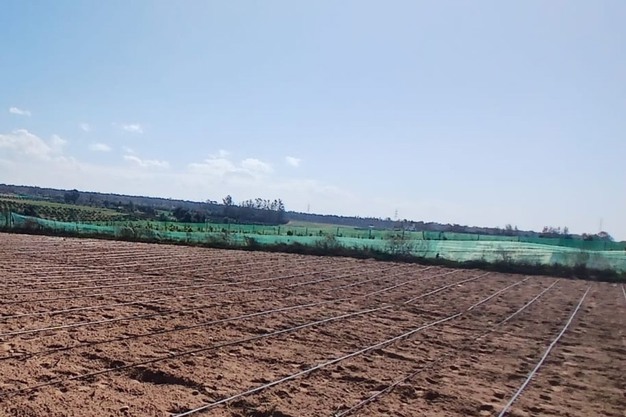 © Rida
The grower adds that rainfall distribution does not benefit all regions of the country equally. He explains, “Regions such as Gharb and Loukkos are doing well, while others such as Oriental and Deraa Tafilalet, Sais plain, Tadla and others continue to suffer a shortage. Producers in Souss Massa will have to continue to rely on seawater desalination, which is only bearable for growers of high-value-added crops and requires secondary water treatment for certain crops such as soft fruits. I believe that under the current conditions, seawater desalination is nevertheless becoming essential in Morocco, although it remains too costly for small-scale growers.”
Aghori adds that rainfall in Morocco at its current level is not sufficient to regenerate the water table, but tempers, “It is nevertheless very welcome because dam reserve levels are improving compared to the end of 2022, rising from 3 billion cubic meters out of 16 to slightly more than 5 billion cubic meters out of 18. Rainfall is also important for the quality of trees used in arboriculture.”
Moroccan media Le360 reports, citing Younes Laabidi, head of water management at the Directorate General of Hydraulics, that the country currently counts sixteen seawater desalination plants in operation, five under construction, and thirteen new projects planned across the country. The same source notes that by 2027, the country’s total desalinated water production capacity is expected to exceed one billion cubic meters per year, and is projected to reach 2.3 billion by 2040.
For more information:
Rida Aghori
ARDIAL
Tel: +212614606183
[email protected]

Source: The Plantations International Agroforestry Group of Companies